
Why we cover our soil: a short lesson in mulch
At Grounded we have covered the soil with pine bark in all the landscaping areas. It looks like a finishing touch, a tidy brown layer around young plants. In practice it is a simple, low-effort way to help a garden through a dry summer, and the same idea works in a pot on a city balcony.
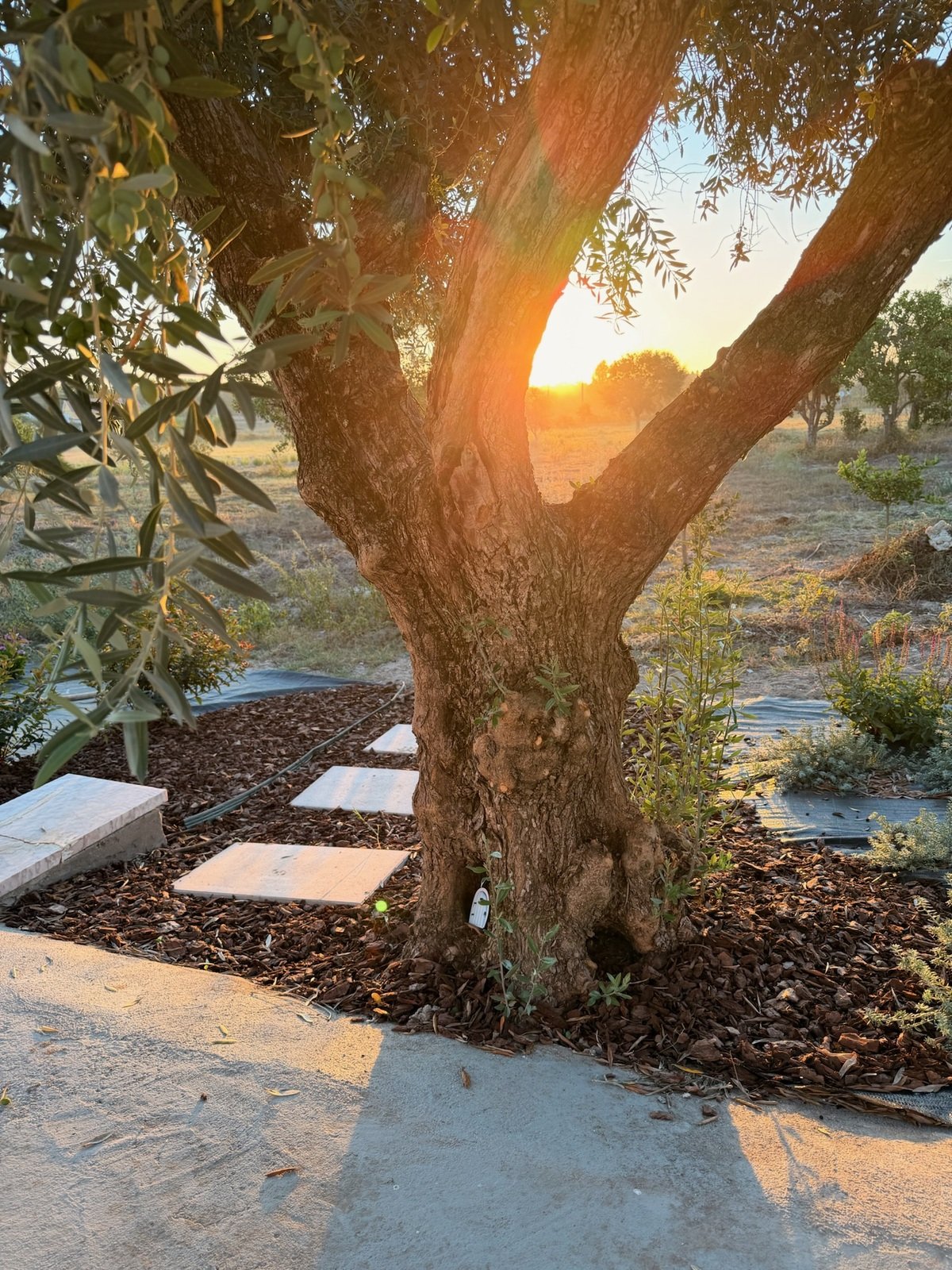
What we did at Grounded
We planted roughly 80 trees and 1,300 shrubs in the garden and created some pathways. Those areas are now fully covered with pine bark. The watering system is set up underneath the mulch, and under it we also laid weed-control fabric (what you will see called landscape fabric in English) to keep weeds from growing.
It was a trade-off. I would have liked to use paper or cardboard, or to prepare the soil better beforehand. But that would have postponed creating the garden by a full year, so we went with the fabric. I chose bark because I like how it looks. It feels premium without losing the natural feel, and it makes a good transition to the more agricultural part of the land that we will build next.
You can see the bark going down in our reel on Instagram.
The idea: keep the soil covered
In a forest, the ground is usually covered by a layer of leaves, needles and fallen wood. Bare soil, like the soil in many gardens and fields, is more exposed. Sun and wind dry it out, heavy rain can compact it and wash it away, and weeds often move in because open ground is an easy place to start.
A layer of mulch imitates that natural cover. A review by horticulture researcher Linda Chalker-Scott, summarised by University of California Cooperative Extension, lists the benefits: less evaporation, so the soil holds water longer; less erosion and compaction; steadier soil temperature, which protects fine roots from extreme heat and cold; and fewer weeds.
Why it matters most in a dry climate
Water is the limit in a Mediterranean summer. Water that evaporates from the surface is water your plants cannot use. The same review notes that an appropriate mulch can reduce the need for irrigation, and in some landscapes can remove it altogether. For young plants that are still building roots, that buffer can make a hard first summer easier.
What to know before you mulch
- Coarse beats fine. Coarse organic mulches let water and air through and moderate temperature better than thick layers of fine material.
- Thicker is not better. A layer of a few centimetres is enough. Keep it off the stems and trunks so they do not stay damp.
- Bark is slow to break down. That makes it long lasting, but it adds nutrients slowly. Mulch protects the soil, it does not replace feeding it.
- The acidity worry is mostly a myth. Extension services at several universities report that pine bark and pine needles do not meaningfully acidify garden soil.
- Colour matters a little. The same review notes that dark bark can warm the soil surface in strong sun, so it is worth watching young leaves in the hottest weeks.
What goes under the mulch: fabric, cardboard or nothing
Many gardeners put a weed barrier under the mulch, as we did. The research is mixed, and it depends on the time horizon. UC Integrated Pest Management lists landscape fabrics (spun or woven polypropylene and polyester) as very effective and relatively long lasting when covered with bark or another mulch, and notes that they allow air and water through. It also notes that brands differ, and that synthetic fabrics can be difficult to remove once they begin to deteriorate.
Washington State University horticulturist Linda Chalker-Scott is more cautious about the long term. Extension writers summarising her work say fabric works well at first, but over the years soil and debris can clog its pores, and weeds can root in the layer that builds up on top. They suggest a thick layer of coarse wood chips as an alternative that suppresses weeds while letting water and air reach the soil.
Which option is right depends on your soil, your climate and how much time you have, and the sources do not agree on one best answer. With more time, we would have liked to use paper or cardboard, or to prepare the soil better beforehand, but that is our preference for our situation, not a rule. Some horticulturists also caution against solid sheet barriers of any kind, because they can limit air and water movement. If you already have fabric down, keep the mulch layer coarse and pull weed seedlings while they are small.
Try it where you live
You do not need a farm. Cover the soil of any pot or planter with a couple of centimetres of bark or wood chips and you may find you need to water less often. Watch it for a few weeks and compare it with an uncovered pot next to it. It is a small experiment, and you will see for yourself whether it works in your conditions.
The builder’s takeaway
Good systems reduce effort by changing conditions instead of adding work. Mulch does not water the plant, pull the weeds or cool the roots. It changes the conditions so that those jobs need less of your effort. Look for that move in your own work, in a garden, a workshop or a team.
Sources: Chalker-Scott, L. (2007), Impact of Mulches on Landscape Plants and the Environment, summarised by University of California Cooperative Extension. On pine and acidity: Oregon State University Extension and NC State Extension. On fabric and sheet barriers: UC Integrated Pest Management, Washington State University Extension (Yakima), Chalker-Scott, The Myth of Landscape Fabric and The Garden Professors.